

YARI Atlas private beta opens on August 15, 2026.
Atlas is a unified data platform for small unmanned vehicles. It brings PX4, ArduPilot, and ROS 2 MCAP logs into one workflow for review, monitoring, debugging, AI-assisted triage, and team collaboration.
Flight-log review is still important. Logs often contain the evidence behind a failed test, a tuning issue, a sensor problem, a navigation warning, or a mission anomaly. But log analysis by itself is too narrow for how unmanned vehicle teams actually work. A useful platform also needs to keep vehicle context, maps, media, notes, dashboards, discussions, and shared findings together.
That is the direction behind Atlas.
We are also being practical about how Atlas is built. YARI Robotics has used available agentic AI development tools to move faster, but the product direction does not come from prompts alone. We designed and built the YARI V6X flight controller, tested it extensively for functionality and reliability, and used Atlas ourselves while reviewing our own test-flight data. That firsthand hardware, firmware, and field-test experience shapes the product. It is also backed by production software experience: YARI's founder has built and managed B2B and B2C software systems used in real production environments.

Watch the YARI Atlas product video.
Why Atlas
Small unmanned vehicle teams collect more than raw flight logs. They collect PX4 ULog files, ArduPilot Dataflash logs, ROS 2 MCAP recordings, screenshots, images, videos, parameter snapshots, weather context, field notes, support threads, and exported reports.
When each piece lives in a different tool, every investigation starts by rebuilding context. A pilot remembers what happened in the field. An autonomy engineer opens plots. A support engineer asks for screenshots. Someone exports a report. The team discusses it in chat, then later has to rediscover which file, flight, note, or decision belonged to the original problem.
Atlas is built to reduce that handoff cost. It gives teams one place to review vehicle data, preserve findings, and continue the conversation around the same record. For a deeper explanation of the product direction, read Why Atlas.
What Atlas Supports Today
The private beta focuses on the workflows teams already need during testing and development:
- PX4
.ulglogs. - ArduPilot
.binlogs. - ROS 2 MCAP
.mcaplogs. - Overview pages with session metrics, maps, weather, and deterministic checks.
- Configurable dashboards with plots, raw messages, maps, 3D scenes, images, and other panel types.
- Notes, media, discussions, and shared reports attached to the vehicle record.
- AtlasAI for first-pass triage from available report evidence.
- Direct BYOK and Router BYOK options for teams that want to use their own AI provider keys.
Atlas is designed for teams building and operating small unmanned aerial, ground, marine, and robotics systems. That includes commercial teams, research teams, builders, support engineers, and autonomy developers who need a clearer path from raw data to shared answers.
For private beta, AtlasAI and deterministic checks are focused first on copter, plane, and VTOL workflows. Atlas can store and organize broader unmanned vehicle data, and support for more platform types will expand over time as the product is validated with real team workflows.
Start With The Overview
The first screen after processing should help the team understand the flight or vehicle session quickly.
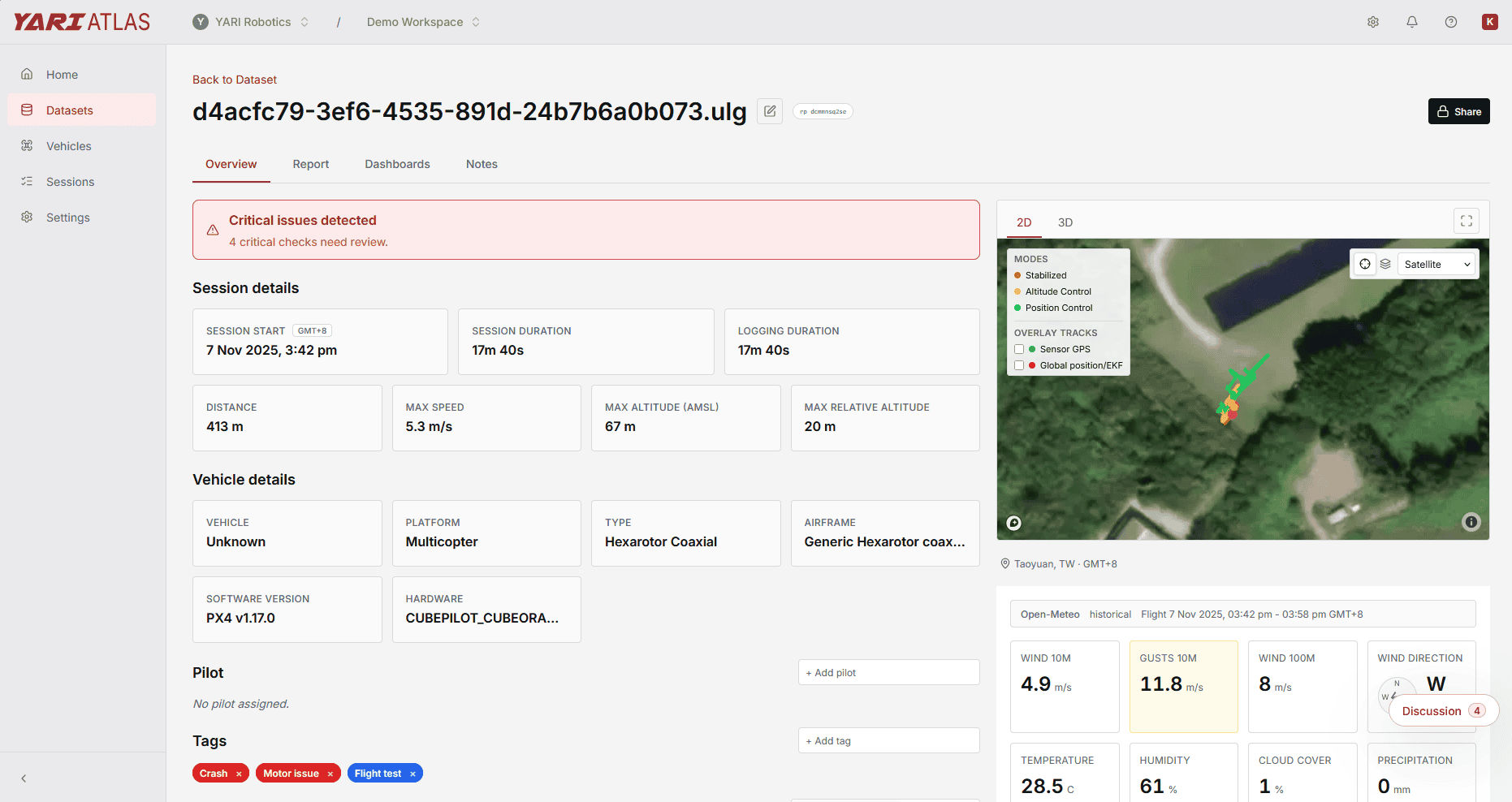
Atlas overview pages bring together high-level session information, vehicle metadata, maps, weather context, and deterministic checks. Instead of starting from a blank plotting canvas, reviewers can first see whether the session has obvious warnings, unusual events, missing data, or signals that deserve deeper attention.
For location-heavy sessions, the overview includes map-based context. Atlas can show 2D and 3D map views so teams can inspect path, altitude, terrain, and vehicle movement from a more practical starting point. For engineering review, deterministic checks help surface known classes of issues before the team spends time searching manually.
The goal is simple: help more people on the team start from the same evidence.
Atlas also keeps familiar reports close to the workflow. PX4 users can open PX4 Flight Review inside Atlas, and ArduPilot users can access ArduPilot WebTools in the same review environment. That gives teams a known starting point before they move into Atlas dashboards, notes, AI-assisted triage, or custom views for deeper investigation.
Go Deeper With Dashboards
Experienced users still need detailed signal inspection.
Atlas dashboards let teams build custom views from indexed vehicle data. Panels can include plots, raw messages, maps, 3D scenes, images, and other data views, so the review can match the question being asked. A controls engineer may want time-series plots. A robotics engineer may want image and 3D scene context from ROS 2 MCAP data. A field team may want map and weather context next to the session notes.
Dashboards are configurable so teams can return to useful layouts instead of rebuilding the same view for every investigation. This keeps Atlas approachable for new users while still giving experienced users room to inspect exactly what matters.

Bring ROS 2 Data Into The Same Workflow
Autonomy teams increasingly work beyond autopilot logs alone. Companion computers, perception pipelines, sensors, cameras, and robot middleware all produce data that affects how a vehicle behaves.
Atlas supports ROS 2 MCAP workflows so teams can bring those records into the same platform as PX4 and ArduPilot data. That means vehicle review can include not only flight-control signals, but also images, 3D scene panels, and other robotics data that helps explain what the system saw and how it responded.
This is a key reason Atlas is positioned as a unified data platform, not only a log viewer. The product is built around the broader autonomy workflow: collect data, inspect evidence, discuss findings, and improve the system.
Part Of The YARI Autonomy Stack
Atlas is also part of the broader YARI autonomy stack for small unmanned vehicles. YARI V6X provides onboard flight-control hardware, while Atlas provides the vehicle-data workflow around testing, ingestion, review, collaboration, AI-assisted triage, and SDK-based analysis.
The first public pieces are intentionally practical: hardware inside the vehicle, software for reviewing what happened after each test, and tools that help teams move from raw data to engineering decisions. This foundation is designed for defense, commercial, research, and builder teams developing small unmanned systems without locking the workflow to a single vehicle type.
Within Atlas, the ecosystem includes three companion pieces:
- YARI Agent runs on a companion computer and syncs logs from the vehicle to Atlas when internet access is available.
- YARI ROS Bridge connects ROS 2 data workflows to Atlas through MCAP logs and live-data integrations.
- YARI SDK gives engineers a path for offline analysis, custom experiments, and batch research workflows outside the Atlas UI.
Use AI Without Losing The Evidence Trail
AtlasAI is designed for first-pass triage and review assistance. It can help summarize a session, point reviewers toward suspicious events, explain which charts or checks may matter, and keep the discussion connected to the report context.
The important part is that AI stays attached to the evidence. AtlasAI is not a replacement for engineering judgment, and it should not become a detached chat conversation away from the vehicle data. It is there to help teams get oriented faster while keeping the underlying report, charts, events, notes, and timestamps available for review.
Teams can use Atlas-managed AI, Direct BYOK, or Router BYOK depending on their model, procurement, and governance needs. Direct BYOK supports provider-specific keys, while Router BYOK gives teams another path to use multiple models through a model router. The Atlas FAQ covers supported formats, AI options, BYOK, retention, and plan behavior in more detail.
Atlas can also be used without AI analysis. The core log-review workflow works without AtlasAI, and AI features are optional, disabled by default, and must be enabled in organization settings before they are used. Before private beta, YARI used 5-10 publicly available log samples for each vehicle type and autopilot firmware family to seed AtlasAI skills. Logs from private beta testing may be used to improve AtlasAI skills only when the relevant AI and feedback settings allow it.
Built For Team Review
Vehicle development is rarely a solo workflow for long.
A pilot may upload the session. A firmware engineer may inspect the warning. A robotics engineer may compare image or 3D scene data. A support engineer may need to explain the finding to a customer. A manager may need a shareable report that captures what happened and what changed.
Atlas keeps notes, media, discussions, dashboards, and shared reports connected to the same vehicle record. That gives the team a cleaner way to move from field testing to engineering review, and from a single issue to a reusable record of what was learned.
Security And Access Controls
Vehicle data can be sensitive. Atlas is built with workspace access controls, role-based access, HTTPS, encryption in transit and at rest, controlled sharing, and encrypted BYOK credentials. Enterprise roadmap items include stronger identity, audit, storage, and governance controls for teams with more demanding requirements. See the Atlas security page for the current security overview.
The private beta is intentionally focused. We want teams to evaluate Atlas with real data, real review workflows, and practical feedback before the product moves to broader availability.
Built On Shared Foundations
YARI Atlas stands on the shoulders of existing robotics, autopilot, and data tooling. PX4, ArduPilot, ROS 2, MCAP, familiar reports, plotting tools, maps, notebooks, and team workflows already carry a lot of engineering value.
We inherited useful patterns and building blocks from the ecosystem instead of reinventing the wheel, and focused Atlas on the product experience around them: bringing vehicle data, review workflows, dashboards, notes, discussions, shared reports, and AI-assisted triage into one controlled workspace. We are grateful to the open-source contributors and maintainers whose work makes this ecosystem possible.
Private Beta And Availability
YARI Atlas private beta opens on August 15, 2026 for select teams.
Private beta also means there may be rough edges. We expect some workflows, checks, AI behavior, dashboards, and integrations to need tuning as teams use Atlas with real data. The purpose of this phase is to stabilize the platform, improve review quality, and close practical gaps before broader availability.
General Availability is planned for January 2027.
If your team works with PX4, ArduPilot, ROS 2 MCAP, vehicle testing, autonomy development, or unmanned vehicle operations, Atlas is built for you.
Teams can request private beta access, review pricing, or explore the YARI Atlas product site.